
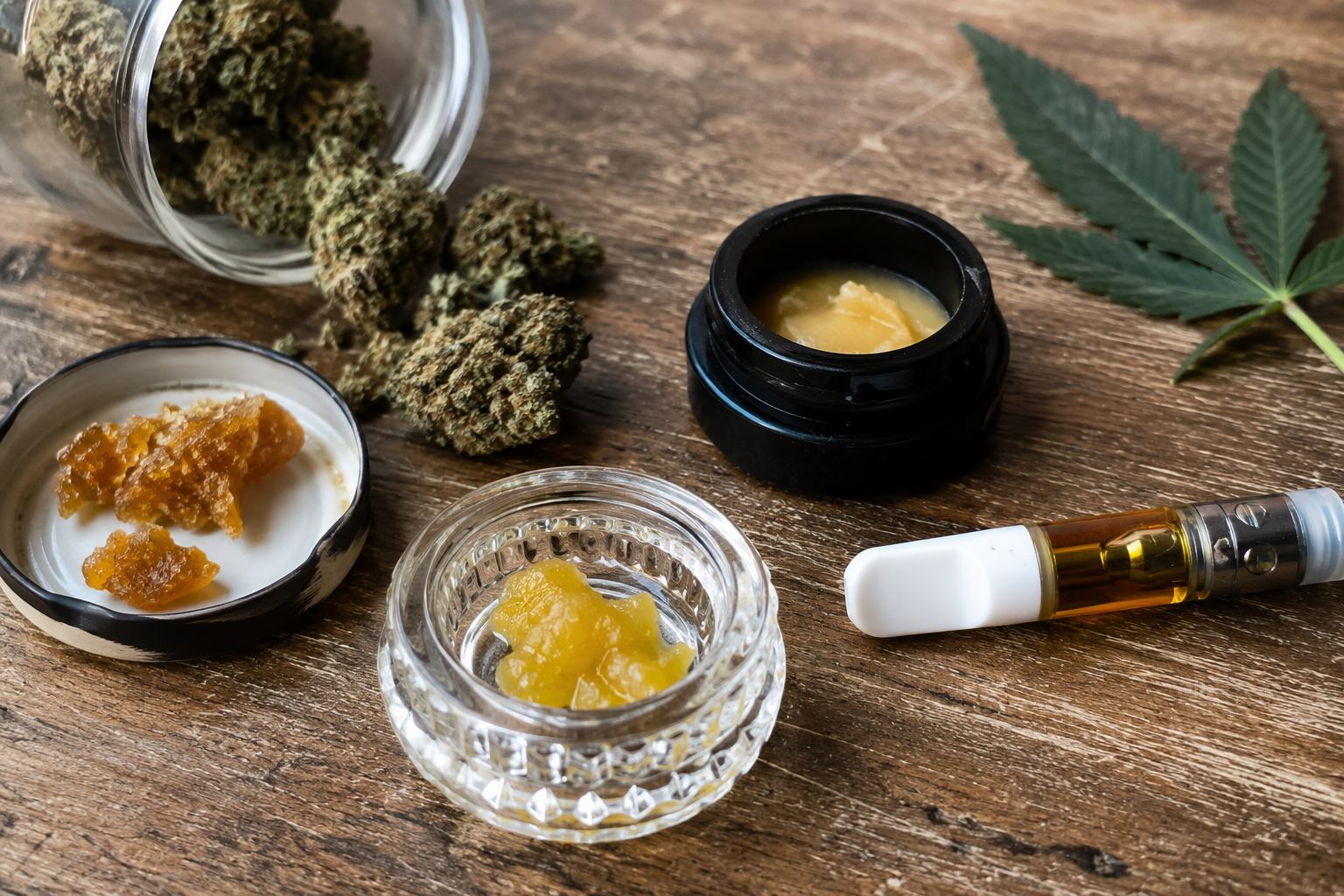
Walk into a dispensary today and it’s easy to feel overwhelmed.
Live rosin. Full spectrum. Distillate. Delta-9. THC-P. Strain-specific terpenes.
Somewhere around the third unfamiliar term, it's tempting to just smile and pretend you know what's going on.
If your reaction is, "I just wanted to buy some weed," you're not alone.
One of the questions we hear most often is also one of the simplest:
"What's the real stuff?"
It's a great question.
What most people are really asking is:
"Which products are the closest representation of the cannabis plant?"
The short answer?
Flower is hard to beat.
Rosin and live rosin are close behind because they're designed to preserve much of the plant's naturally occurring cannabinoids, terpenes, and other compounds.
Distillate takes a different approach. It's intentionally refined to isolate specific cannabinoids, most commonly THC, CBD, or CBG
They're simply designed to deliver different experiences.
You don't need to become a cannabis expert to understand why.
A few key concepts can make shopping for cannabis a whole lot less confusing.
Let's break it down.
Cannabis Is More Than THC
For years, the cannabis conversation has revolved around one number: THC percentage.
Higher must be better...right?
Not necessarily.
In fact, two cannabis products can have nearly identical THC percentages and create surprisingly different experiences.
That's because THC is only one piece of a much bigger picture.
THC is incredibly important. It's the primary cannabinoid responsible for the classic cannabis "high." But judging cannabis by THC alone is a bit like judging a band by the drummer.
The drummer matters.
You just wouldn't want them playing a solo for the entire concert.
Cannabis naturally produces more than 100 cannabinoids. THC, CBD, and CBG are just a few of the better-known examples. Together with naturally occurring compounds called terpenes, they help shape the aroma, flavor, and overall character of each strain.
That's one reason two products with similar THC percentages can smell different, taste different, and create very different experiences.
The Whole Plant Matters
Imagine you're choosing between two gummies.
Both contain 10 mg of THC.
One is made with THC distillate.
The other is made with live rosin.
If you only looked at the THC number on the label, you'd probably assume they'd be pretty much the same.
Not necessarily.
THC is just one of hundreds of naturally occurring compounds found in cannabis. Live rosin preserves many more of those compounds, while distillate is refined to isolate specific cannabinoids, most commonly THC.
Researchers continue to study what's known as the entourage effect, the idea that cannabinoids, terpenes, and other naturally occurring compounds may work together to shape the overall experience. While the science is still evolving, many consumers report that full-spectrum products feel different than products made primarily with THC distillate alone.
Think of it like music.
You can listen to a single instrument.
Or you can hear the full band.
If your goal is to experience the richness of the whole performance, you'll probably choose the full band.
That's why two products with the exact same THC content can feel surprisingly different.
So...What Are Terpenes?
We've mentioned terpenes a few times, but what are they exactly?
Terpenes are naturally occurring compounds that give plants their distinctive aromas. They're responsible for the citrus, pine, berry, garlic, diesel, or earthy notes that make one cultivar smell completely different from another.
Researchers are also studying how terpenes may work alongside cannabinoids to shape the overall experience. That's one reason two cultivars with similar THC and cannabinoid levels can smell different, taste different, and feel different.
Here are three you'll come across often:
Limonene – Commonly associated with citrus aromas and an uplifting, energetic experience.
Myrcene – Earthy and herbal, often associated with a more relaxing, calming experience.
Pinene – Fresh pine aroma, commonly associated with mental clarity and focus.
These aren't guarantees. Everyone's experience is different, and the science is still evolving. But understanding terpenes gives you another way to look beyond THC when choosing cannabis.
Then What Are Delta-8, HHC, THC-P, and Everything Else?
This is where things can get confusing.
Some cannabinoids occur naturally in cannabis but only in tiny amounts. Producing enough of them for commercial products often requires additional processing, conversion, or refinement.
That doesn't automatically make those products good or bad.
It simply means they're different.
Rather than asking, "Is this the real stuff?" ask something much more useful:
"What's the cannabis ingredient in this product?"
Is it flower?
Live rosin?
Rosin?
Distillate?
Isolate?
The answer tells you much more about how the
product was made than the THC percentage ever will.
Understanding the Spectrum
By now, you've probably figured out there isn't just one "right" way to make a cannabis product.
Some products are designed to preserve as much of the original plant as possible.
Others are intentionally refined to deliver consistency, potency, or a specific cannabinoid.
One important thing to keep in mind.
When people ask for "the real stuff," they're usually not asking for more THC. They're trying to describe an experience that's difficult to put into words.
Distillate delivers THC, but many people find the experience feels like something is missing. Flower and live rosin preserve much more of the cannabinoids, terpenes, and other naturally occurring compounds found in the plant. Many consumers describe the result as feeling more complete and more like the original plant.
That's also one reason you'll usually see flower and live rosin priced higher. They're designed to preserve more of what the plant naturally produces, and they're generally more labor intensive to make.
Once you understand how these products are made, the differences start to make a lot more sense. If your goal is to experience as much of the original plant as possible, flower and live rosin are where you'll find it.
If You're Looking for the Closest Thing to the Plant...
If your goal is to experience cannabis in a form that's as close to the original plant as possible, these are great places to start.
Flower
If cannabis had an "original recipe," this would be it.
Flower is simply the harvested and cured cannabis plant. It naturally contains cannabinoids, terpenes, flavonoids, and dozens of other compounds working together, just as the plant produced them.
Live Rosin
Live rosin is about as close as a concentrate can get to the living plant.
It's made from freshly harvested, frozen cannabis using only ice water, heat, and pressure. No chemical solvents. The goal is to preserve as much of the plant's original cannabinoid and terpene profile as possible.
Rosin
Rosin follows the same solventless philosophy but typically starts with cured flower or hash instead of fresh frozen cannabis.
The result is another concentrate that retains a broad range of the plant's naturally occurring compounds while using a remarkably simple extraction process.
Live Rosin Gummies
Not all gummies start with the same ingredient.
Many are made with THC distillate. Live rosin gummies start with...you guessed it...live rosin.
That means they preserve more of the plant's original cannabinoid and terpene profile than gummies made with distillate alone, giving consumers another way to enjoy a more full-spectrum cannabis experience.
That's because understanding what a product is made from is often just as important as knowing how much THC it contains.
Two Questions Every Consumer Should Ask
You don't need to memorize cannabinoid names or earn a chemistry degree to shop with confidence.
Just ask these two questions.
1. What's the cannabis ingredient in this product?
Is it:
Live rosin?
Rosin?
Full-spectrum extract?
Distillate?
An isolate?
A knowledgeable budtender should be able to answer that and give you recommendations for to what you are looking for.
2. Is this made with the original extract or mostly distillate?
Cannabis marketing can be...creative.
A package might say live, strain-specific, or terpene-infused, while the primary cannabinoid ingredient is still distillate.
That doesn't mean it's a bad product. It simply means those words don't always tell the whole story.
Understanding what's actually in the product will almost always tell you more than the marketing on the front of the package.
Looking Beyond the Label
Imagine buying a granola bar that proudly says "Sweetened with Honey." Most people would assume honey is the primary sweetener. But if you turned the package over and found corn syrup listed before honey, you'd probably think differently about what you were buying.
The statement on the front wasn't necessarily false. It just didn't tell the whole story.
Cannabis products can be similar.
As live rosin has become more popular, you'll sometimes see products prominently labeled live rosin gummies even though distillate is still the primary cannabis ingredient and live rosin has been added in a smaller amount. Two products may use the same words on the front of the package while being made very differently.
That's why it's worth looking beyond the marketing and understanding what's actually inside. If a product is labeled "live," ask whether it's made primarily with live rosin or whether it's a distillate product with live rosin or live terpenes added. Those are different products, and understanding the difference will help you choose the experience you're looking for.
Why This Matters for Dispensaries
Understanding the product is only half the equation. Helping customers understand it is where great dispensaries stand apart.
Today's cannabis consumers are asking better questions than ever before.
They're looking beyond THC percentage. They want to know how a product was made, what's actually in it, and why two products with the same THC can create completely different experiences.
The dispensaries that earn lasting trust won't just point customers to the highest THC percentage. They'll help customers understand what they're buying and why it might be the right fit.
When customers understand the product, buying cannabis becomes less intimidating. They leave feeling confident are are more likely to have the experience that keeps them coming back.
The Bottom Line
When people ask for "the real stuff," they're usually not asking about legality or potency.
They're really asking:
"What's closest to the cannabis plant?"
The answer has a lot more to do with what's in the product than the THC percentage on the label.
Choosing cannabis by THC percentage alone is a bit like choosing a bottle of wine based only on its alcohol content.
It tells you something, but probably not whether you'll actually enjoy what's inside.
A better approach is to look at what the product is made from, how it was made, and how much of the original plant made it into the final product.
The good news?
You don't need to memorize cannabinoids or impress anyone with words like sesquiterpenes (bonus points if you can pronounce it).
You just need to ask two simple questions:
What's the cannabis ingredient in this product?
Is it made with the original extract or mostly distillate?
Those two questions will tell you far more than the THC percentage ever could.
And a good budtender won't just know the answers. They'll be happy you asked.
We spend months making thousands of decisions in the grow. It's worth taking a few minutes to help customers understand why those decisions matter.
They just need honest information. Because the more you know, the better your choices become.
Quick Takeaways
If you only remember three things from this article, make them these:
✅ THC percentage is only part of the story.
✅ How a product is made matters just as much as how much THC it contains.
✅ The best question you can ask is, "What's the cannabis ingredient in this product?"